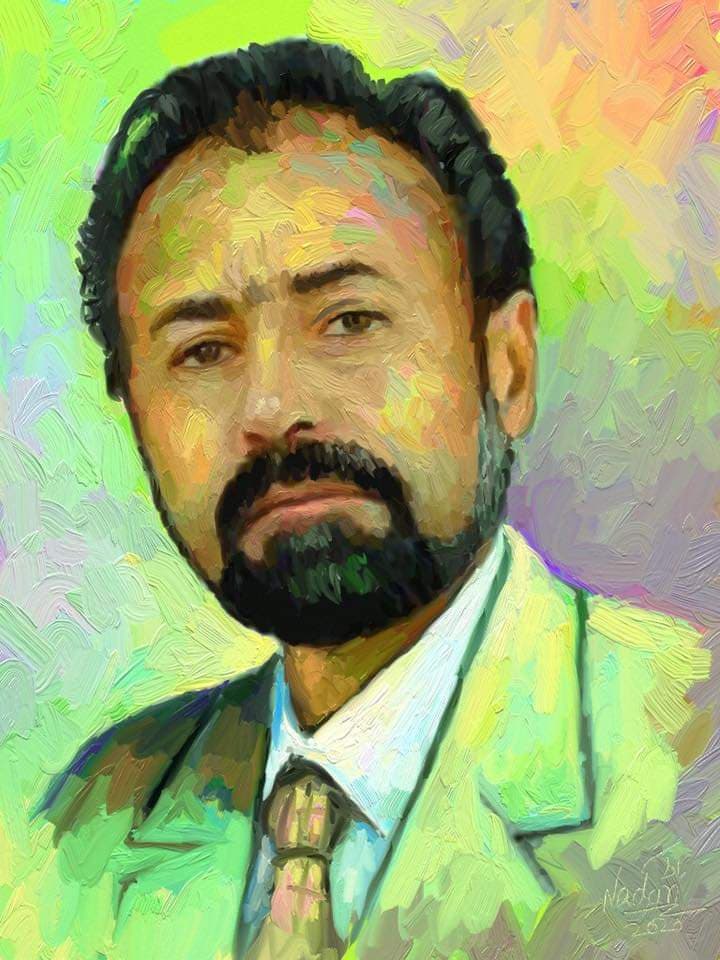
Portrait painted by Hanif Shabgard, Afghan artist
The artist
Dr. Mohammad Yousof Asefi
Artist
Physician
Cultural Preservationist
Born
1960
Kabul, Afghanistan
Based
Tempe, Arizona, USA
Afghan
Complete Biography
Early Life and Formation
Mohammad Yousof Asefi was born on June 3, 1960, in Kabul, Afghanistan. His father was a career government employee in the customs department. Growing up in the Afghan capital, Asefi developed an early interest in drawing and the visual arts, though formal training would come later. He graduated from Habibia High School in 1980 and immediately entered three years of compulsory military service in the Afghan army. It was during this period that he received his first serious instruction in painting from Nasrullah Sarwari, one of the most accomplished Afghan artists of his generation. He also studied under Ghulam Sediq Sediq, another renowned painter. These formative years under two masters laid the foundation for a career that would span more than four decades.
Medical Training and Artistic Awakening
In 1983, Asefi enrolled at the Kabul Medical Institute, graduating with his MD in general medicine in 1989. While pursuing his medical degree, he joined the Afghanistan Artists' Association in 1984 and began exhibiting and selling his paintings. In 1985, he held his first solo exhibition inside the Kabul Medical University, which drew considerable appreciation. By 1988, he had won a gold medal at an exhibition organized by the Ministry of Higher Education. He participated in two exhibitions in Dushanbe, Tajikistan, in 1989, earning the Abu Ali Sina honorary medal. After graduating, he practiced internal medicine in Kabul while continuing to paint with increasing intensity. The tension between his two vocations grew until 1995, when he made the decisive choice to abandon medicine entirely and devote himself to art.
Rise to Prominence
By the early 1990s, Asefi had established himself as one of Afghanistan's foremost painters. Around 1991, Prime Minister Fazal Haq Khaliqyar personally opened his art show at the hall of the Artists' Union of Afghanistan, presenting him with a medal and later commissioning him to decorate the Prime Minister's building. About a year before the Taliban seized power, officials under President Burhanuddin Rabbani asked Asefi to decorate both the presidential palace — the Arg — and the Foreign Ministry. More than sixty of his paintings hung between the two locations. His works also adorned the Nangarhar Palace, Bank-e-Millie Afghan and its Zabuli Museum, De-Afghanistan Bank, Afghanistan International Bank, the Ministry of Public Health, and numerous other public and private buildings. In 1995, after an exhibition at the Kabul Municipality, President Rabbani gifted him a plot of land in recognition of his talent and years of work — the future site of the Asefi Art Gallery.
Saving Art from the Taliban
When the Taliban seized Kabul in September 1996, they imposed a sweeping ban on all depictions of living creatures — paintings, photographs, and sculptures were ordered destroyed. In the regime's first days, around 300 paintings stockpiled at the Ministry of Information and Culture — works by many Afghan artists, some by Asefi himself — were destroyed, and about seventeen of his paintings were torn from the walls of the presidential palace, including his beloved painting of Buzkashi, the traditional Afghan horseback sport. In 1998, officials at the Foreign Ministry — who knew his pre-Taliban restoration work for the ministry — approached Asefi about repairing war-damaged paintings. He accepted, and quietly began a far more dangerous undertaking. Working alone and in absolute secrecy, he painted watercolor foliage and landscapes over the human figures and animals in each canvas. Because the originals were oil-based, the watercolor could later be wiped away with a wet sponge, leaving the original work intact. At the Foreign Ministry he altered 42 paintings — most of them valuable works by foreign artists, alongside some of his own. From 1999, with permission obtained through the Minister of Information and Culture, he extended the work to the National Gallery, where Deputy Said Enayat Ullah, aware of the true nature of his work, served as a lookout, alerting him when Taliban members entered the building. After the Taliban destroyed the Bamiyan Buddhas in March 2001 and turned toward the gallery's collection, the concealment became a race — in all, he altered about 80 paintings there, and genuinely restored about 70 damaged works across both institutions, the cover story that made the deception possible. Throughout this period, he continued painting in secret at his home — landscapes with people and animals that he could neither show nor sell. He told no one what he was doing. Discovery would have meant imprisonment, beatings, or death.
The Revelation and International Fame
After the Taliban were driven from Kabul in late 2001, Asefi spent seven months carefully removing the watercolor from every canvas he had altered, revealing the original figures beneath. In December 2001, a fellow member of the Artists' Union organized a press event at the National Gallery. Twenty-five international media organizations attended as Asefi demonstrated his technique: a wet sponge moved slowly across a canvas, and a girl holding a basket of flowers emerged from beneath the paint. The story spread around the world overnight. In February 2002, Hamid Karzai, then head of the interim government, attended the formal reopening of the National Gallery and watched Asefi repeat the demonstration. In the years that followed, he was interviewed by The New York Times, The Washington Post, Radio Free Europe, Voice of America, and dozens of other outlets. In 2004, National Geographic filmed a documentary — "Lost Treasures of Afghanistan" — and nominated him for an international award. In 2005, the U.S. National Endowment for the Humanities awarded him a commendation for his efforts to protect Afghan culture. In early 2002, Ryan C. Crocker — the American diplomat who had just reopened the U.S. Embassy in Kabul — visited the National Gallery, where Asefi unveiled a concealed painting before him; later, former Ambassador Ronald E. Neumann sought him out after seeing one of his paintings in President Karzai's office. Foreign Minister Dr. Abdullah Abdullah commissioned him to redecorate the Foreign Ministry. President Karzai asked him to redecorate the presidential palace and the Marmarin Palace. A room in the National Gallery was named after him.
International Exhibitions
Through the Ministry of Information and Culture, Asefi received invitations to art events around the world. He visited the national art theater of Indonesia in 2002 and participated in the Global Village exhibition in Dubai in 2003. In 2007, he became the first Afghan artist invited to participate in the art competition held by the South Asian Association for Regional Cooperation (SAARC), held that year in Rajasthan, India. He continued to participate in SAARC events across South Asia for the next decade — in Bhutan (2010, where his work "Contemplation" was recognized as a Master Art Piece), Sri Lanka (2012, 2018), Bangladesh (2012, 2014), Maldives (2013), Afghanistan (2015), and Nepal (2018). In 2012, he was included in dOCUMENTA 13, the prestigious contemporary art exhibition in Kassel, Germany, held that year under the theme of collapse and recovery: the curatorial team traveled to Kabul, interviewed him, and purchased his painting "Dare Shamali" (2011), which was displayed in the rotunda of the Museum Fridericianum. He also exhibited in New Delhi (2006), Tehran (2013), and held solo exhibitions in Sydney and Melbourne, Australia, in 2020.
Teaching and Mentorship
Beyond his own artistic practice, Asefi dedicated himself to nurturing the next generation of Afghan artists. At the Asefi Art Gallery, he organized painting classes that drew dozens of young and enthusiastic Afghans eager to learn. The gallery served as both a display space and an academy — a place where students could study technique, art history, and the cultural traditions of Afghanistan under the guidance of one of the country's most accomplished painters. For Asefi, teaching was inseparable from his broader mission of cultural preservation. A generation of Afghans had grown up knowing only war; through art education, he sought to reconnect them with their heritage and give them the tools to express their own experiences. Many of his students went on to develop their own artistic practices, carrying forward the traditions he had worked to protect.
Life in America
In 2022, Asefi accepted a fellowship offered by Arizona State University as a research scholar. He arrived in the United States on April 6, 2022, with his wife Nahid and youngest son Mosawer. In October 2022, forty-three of his paintings were exhibited at ASU's Harry Wood Gallery under the title "War and Emotion." The works, many painted since leaving Afghanistan, included Arizona landscapes — the Grand Canyon, the Sonoran desert — alongside pieces addressing the ongoing crisis in Afghanistan, including the struggle of women denied access to education. In October 2024, ASU's Center for the Study of Religion and Conflict — where he serves as the inaugural artist-in-residence — presented "The Brush is Mightier," a gallery open house during which he painted new works live before the audience. In July 2026, with support from a National Endowment for the Humanities Chairman's Grant, his work travels to Washington, D.C., for the exhibition "Repression, Resilience and Renewal" (July 21–23). From the presidential palace in Kabul to the American capital, his career now spans four continents, twelve countries, and more than four decades of unbroken artistic practice.
Achievements & Impact
Cultural Preservation
Saved over 120 paintings from Taliban destruction at the Foreign Ministry and National Gallery
Developed a watercolor concealment technique to hide banned depictions of living creatures
Spent seven months restoring concealed paintings after the fall of the Taliban in 2001
Received presidential appreciation and international commendations for preservation efforts
Artistic Output
Thousands of completed paintings across Realism, Impressionism, Expressionism, Symbolism, and Abstract styles
More than four decades of continuous artistic practice (1981 – present)
Works in oil on canvas using both brush and palette knife techniques
Subjects spanning Afghan landscapes, cultural heritage, political commentary, and Arizona vistas
International Recognition
Exhibitions across twelve countries on four continents
Featured in National Geographic documentary "Lost Treasures of Afghanistan"
Interviewed by The New York Times, The Washington Post, Radio Free Europe, and Voice of America
Included in dOCUMENTA 13, Kassel, Germany (2012)
First Afghan artist at the SAARC international art competition (2007)
Public Commissions and Institutional Roles
Decorated the Presidential Palace, the Arg, and the Marmarin Palace at the direction of President Karzai
Artworks displayed in the Afghan Parliament (old and new buildings), the Prime Minister's building, and the Foreign Ministry
A room in the National Gallery of Afghanistan named in his honor
Cultural advisor to the Meshrano Jirga (Senate) from 2018
Member of the Arts High Council of Afghanistan and the Afghanistan Artists' Association
Education and Mentorship
Founded painting classes at the Asefi Art Gallery for young Afghan artists
Trained dozens of students in technique, art history, and Afghan cultural traditions
Established the AAG as both a gallery and an educational center
Research scholar at Arizona State University (2022 – present)
Awards & Recognition
Research Fellowship
Arizona State University
Accepted a fellowship as a research scholar at Arizona State University, where he held the exhibition "War and Emotion" at the Harry Wood Gallery.
Cultural Advisor to the Senate
Meshrano Jirga (Upper House), Afghanistan Parliament
Appointed cultural advisor to the Upper House of the Parliament of Afghanistan.
dOCUMENTA 13 Inclusion
dOCUMENTA, Kassel, Germany
His painting "Dare Shamali" (2011), purchased from him in Kabul by the curatorial team, was displayed in the rotunda of the Museum Fridericianum and recorded in the official catalog and Logbook of dOCUMENTA 13, one of the world's most prestigious contemporary art exhibitions.
Master Art Piece Recognition
SAARC Art Camp, Thimphu, Bhutan
His painting "Contemplation" was recognized as the Master Art Piece at the SAARC art camp and exhibition in Bhutan.
First Afghan Artist at SAARC
South Asian Association for Regional Cooperation
Became the first Afghan artist to participate in the SAARC art competition, held in Rajasthan, India.
Commendation for Cultural Preservation
U.S. National Endowment for the Humanities
Awarded a certificate and diploma by the USA's top cultural body for safeguarding Afghanistan's art gallery artworks.
Presidential Appreciation
President of the Islamic Republic of Afghanistan
Received appreciation from the President for protecting the National Gallery's monuments during the Taliban regime.
First Rank — International Handicraft and Painting
Dubai International Exhibition
Afghanistan achieved first rank at the international handicraft and painting exhibition in Dubai, represented by Dr. Asefi.
Honorary Medal from the President
Government of Afghanistan
Awarded an honorary medal by the President of Afghanistan for the exhibition "Afghanistan's Historical Monuments."
Abu Ali Sina Honorary Medal
Medical Institute Festival, Dushanbe, Tajikistan
Received the Abu Ali Sina honorary medal and the fiftieth festival medal at exhibitions in Dushanbe, Tajikistan.
Gold Medal — Art Exhibition
Ministry of Higher Education, Afghanistan
Awarded the gold medal at an art exhibition organized by the Ministry of Higher Education in Kabul.
Press Coverage
NEH Sponsors Exhibition and Panel on Art and Religious Freedom
2026-07National Endowment for the Humanities
“Announcing the July 2026 Washington, D.C. exhibition of Dr. Asefi's work, supported by an NEH Chairman's Grant.”
The brush is mightier: One man's mission to rescue art from the Taliban
2024-10ASU News
“On his life as artist-in-residence at ASU's Center for the Study of Religion and Conflict.”
Meet Dr Mohammad Yousef Asefi: the man who saved Afghan art from the Taliban
2019-03The National
“An extended interview from inside the Kabul gallery — on the bombing, the rebuilding, and why Kabul needs culture.”
Lost Treasures of Afghanistan
2004National Geographic
“National Geographic filmed a documentary about Dr. Asefi's efforts to save paintings from the Taliban and nominated him for an international award.”
Coverage of the National Gallery Reveal
2001-12The New York Times
“Among the twenty-five international media organizations present when Dr. Asefi first demonstrated how he had concealed and preserved paintings under the Taliban's rule.”
Coverage of the National Gallery Reveal
2001-12The Washington Post
“Reported on Dr. Asefi's technique of painting watercolor over oil to save banned artworks, and the dramatic public demonstration at the National Gallery.”
Kabul Artists Tricked Taliban To Save Banned Paintings
2001-12Radio Free Europe / Radio Liberty
“Filed from the December 13, 2001 press conference at the National Gallery, where Dr. Asefi told his story publicly for the first time.”
Afghanistan Opens First Post-Taleban Art Exhibit
2001-12Voice of America
“Covered the National Gallery's first post-Taliban exhibition, reporting how Dr. Asefi altered 122 paintings and helped save 400 works in total.”
In His Own Words
“I felt like the Taliban was out to destroy the culture of Afghanistan. I had to do something to try to save the art.”
— Dr. Mohammad Yousof Asefi, on his decision to conceal paintings
“I covered the figures with watercolor paint. The oil underneath was permanent. A wet sponge wipes the water away.”
— Dr. Mohammad Yousof Asefi, describing his technique, Kabul, December 2001
“What is important is for the art to survive — an explosion can't kill an artist.”
— Dr. Mohammad Yousof Asefi, The National, 2019