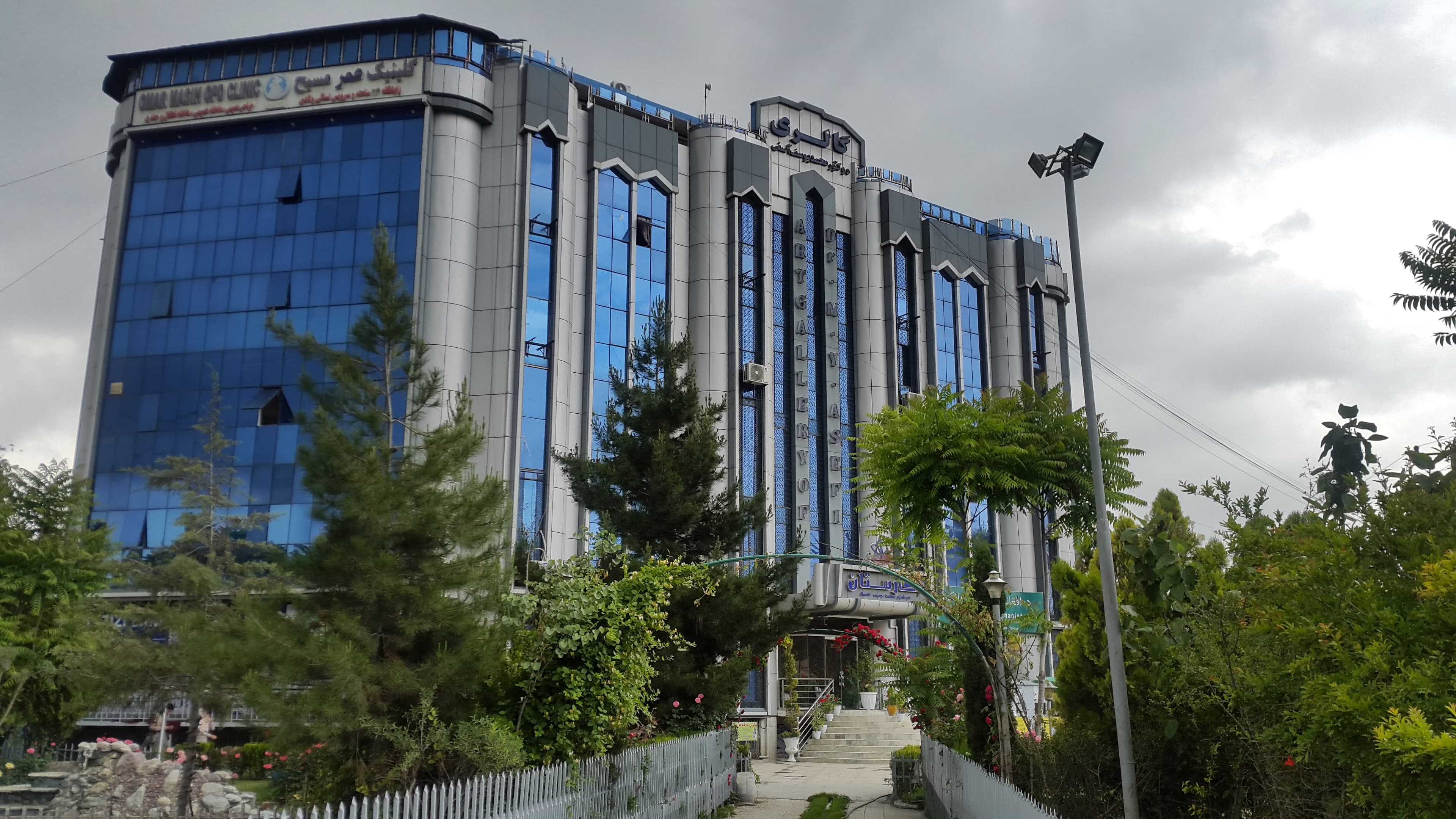
Asefi Art Gallery Building

Asefi Art Gallery

A Cultural Landmark in the Heart of Kabul

Founded in 2003 by Dr. Mohammad Yousof Asefi — one of the largest private gallery spaces in Afghanistan

6
Floors
250+
Artworks Displayed
2003
Founded
2021
Operated Until

Gallery Journey

Navigate through the story of the Asefi Art Gallery

Origins

From Presidential Commissions to a Plot of Land

In the years before the Taliban seized power, Dr. Asefi's paintings hung in Afghanistan's most important buildings — the presidential palace, the Foreign Ministry, the Prime Minister's residence. More than sixty of his works were displayed between the Arg and the Foreign Ministry alone. He used the income from these commissions to purchase a plot of land in Kabul. In 2003, he founded the Asefi Art Gallery on that land, driven by a conviction that Afghanistan needed accessible, academic art spaces. Over the following years, he built a mixed-use, five-story building. In 2012, he added a sixth floor, where his family lived.

Founded in 2003 on land purchased with commission income

Built over several years into a five-story structure

Sixth floor added in 2012 as the family residence

Driven by the mission to create accessible art spaces

Origins - Image 1
Origins - Image 2
Origins - Image 3

The Building

Six Stories Rising Over Kabul

The Asefi Art Gallery stands as one of the largest private gallery spaces in Kabul — second in size only to the National Gallery of Afghanistan. The six-story building was designed as a mixed-use cultural center, housing gallery floors for permanent and rotating exhibitions alongside spaces for education and community engagement. For a time, the building also housed a university. The scale of the structure reflected the scale of Dr. Asefi's ambition: not merely a place to display his own work, but a cultural institution capable of serving a city and a country.

One of the largest private galleries in Kabul

Second only to the National Gallery in size

Mixed-use cultural center

Housed gallery, educational, and residential spaces

The Building - Image 1
The Building - Image 2
The Building - Image 3

Teaching and Community

An Academy as Much as a Gallery

The Asefi Art Gallery was never intended as a static display space. It was a living center of cultural education. Dr. Asefi organized painting classes that drew dozens of young Afghans eager to learn. Students studied technique, art history, and the cultural traditions of Afghanistan under the guidance of one of the country's most accomplished painters. The gallery also welcomed diverse groups of visitors — from students and families to dignitaries and international guests — each visit becoming a journey through Afghan history and artistic expression. For Asefi, teaching was inseparable from his broader mission: reconnecting a war-scarred generation with its cultural heritage.

Painting classes for dozens of young Afghan artists

Instruction in technique, history, and cultural traditions

Visitors ranging from students to international dignitaries

Education as a core part of the gallery's mission

Teaching and Community - Image 1
Teaching and Community - Image 2
Teaching and Community - Image 3
Teaching and Community - Image 4

Under Threat

Two Bombings and a Family Under Siege

In 2014, while preparing for the gallery's formal opening, Dr. Asefi received a phone call from the Taliban. They warned him that they were aware of his affiliations with American officials and that the building housed a university with female students who did not conform to the Taliban's dress codes. He cancelled the opening and had the university vacate the premises. About six months later, a bomb detonated at the south gate of the gallery property, causing considerable damage to the information office. About six months after that, a far larger bomb — packed inside a car — detonated along the west wall on the main road. The explosion shattered the gallery's glass facade, destroyed most of the window frames, and caused extensive damage to the walls, ceilings, and paintings inside. Dr. Asefi's wife and sons were in the building; his son Najim was in the adjacent information office. Mosawer, still a teenager, was at school. Several family members sustained injuries. The psychological toll was severe — Mosawer struggled for months afterward.

Taliban phone call forced cancellation of formal opening

First bomb at south gate damaged the information office

Second car bomb shattered the glass facade and damaged paintings

Family members inside sustained injuries

Under Threat - Image 1
Under Threat - Image 2
Under Threat - Image 3
Under Threat - Image 4

Before & After Restoration

See the remarkable recovery of the gallery

Gallery before restoration
Before
Gallery after restoration
After

Reconstruction and Reopening

Rebuilt Without Government Assistance

Dr. Asefi submitted requests to the Afghan government for assistance with repairs. He received none. Over the next several years, he spent a considerable amount of his own money rebuilding the gallery. His only installation artwork — a sculpture assembled from the debris of the bombing — stands as a testament to what was endured and a question directed at those responsible: Why were innocent Afghans the target? The gallery reopened in 2018. In the same year, Dr. Asefi was appointed cultural advisor to the Meshrano Jirga, the Upper House of the Afghanistan Parliament. The gallery operated continuously from 2018 until May 10, 2021.

Rebuilt entirely at personal expense

No government assistance received

Installation artwork created from bombing debris

Reopened in 2018 and operated until May 2021

Reconstruction and Reopening - Image 1
Reconstruction and Reopening - Image 2
Reconstruction and Reopening - Image 3
Reconstruction and Reopening - Image 4

The Mission Continues

Though the Asefi Art Gallery in Kabul is no longer operational, the mission it represents endures. Dr. Asefi continues to paint, exhibit, and teach from Arizona — ensuring that Afghan cultural heritage remains alive for future generations.